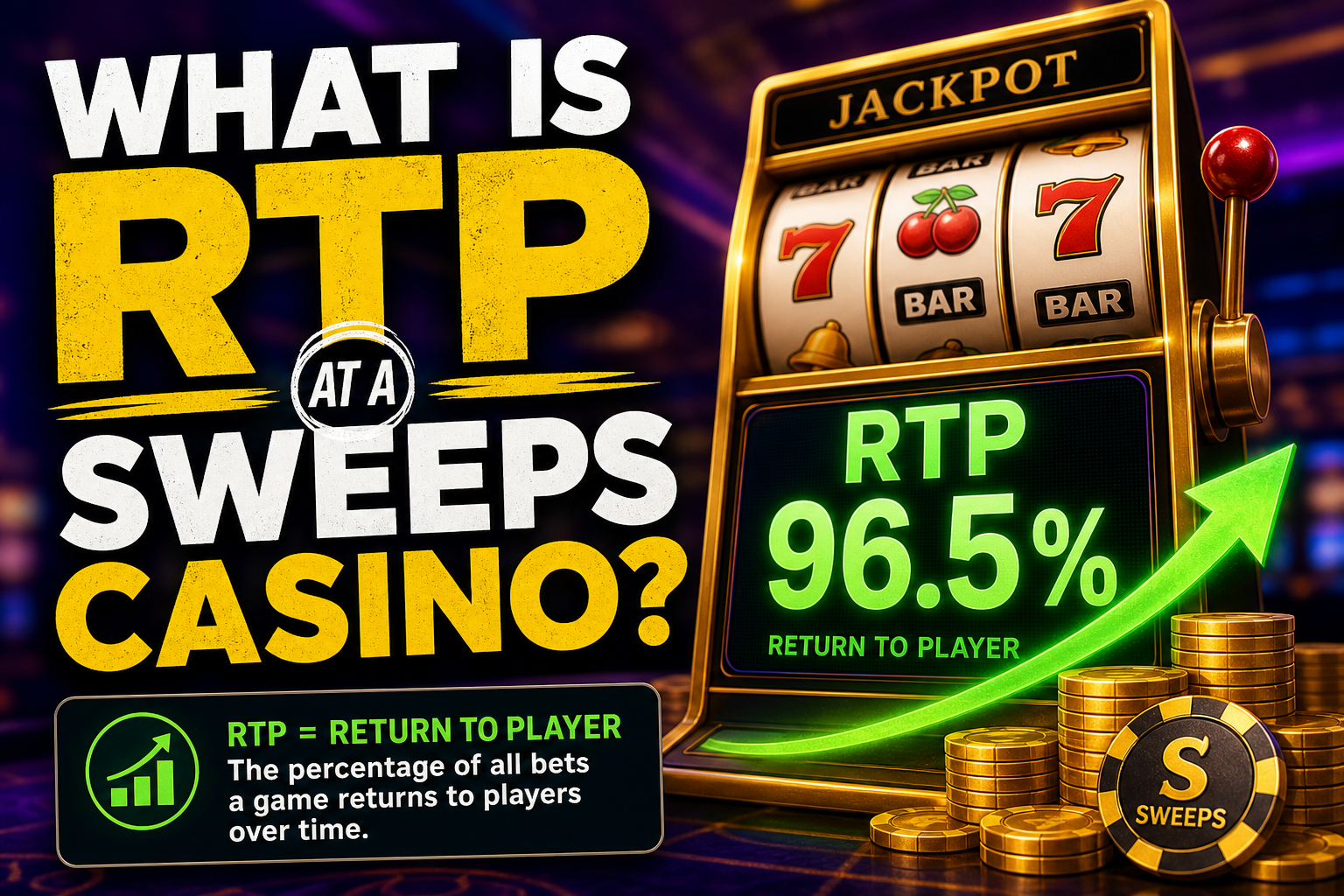
Short Answer: RTP at a sweeps casino means Return to Player: the percentage of total wagers a slot is mathematically expected to return over a very large number of spins. A 96% RTP slot is designed to return about $96 per $100 wagered in the long run. It is not a promise for one session, but it is useful for comparing games.
By Maya Reed, Sweeps Flow Editorial | Updated September 2026
If you have ever stared at a 96% RTP slot and thought, “Okay babe, where is the 96%?” you are not alone.
The terms are doing the most, and the math needs a little supervision.
This guide explains what RTP means in sweepstakes casino play, how it connects to house edge, why a high-RTP slot can still run cold, how RTP compares with volatility and hit frequency, and whether sweepstakes casino RTP is different from real-money casino RTP.

Quick Take: Sweeps Casino RTP in Plain English
- RTP means Return to Player. It is the long-run percentage a slot is designed to return to players.
- RTP is not a session promise. Your own session can land far above or far below the listed percentage.
- House edge is the other side of RTP. A 96% RTP slot has a 4% long-run house edge.
- Higher RTP is usually better, all else equal. But volatility, hit frequency, bonus terms, and redemption rules still matter.
- The same slot can have different RTP versions. Always check the in-game info screen at the operator where you are playing.
- Sweepstakes RTP and real-money RTP are usually the same when the same game uses the same RTP version. The bigger differences come from bonuses, playthrough, and redemption rules.
What Does RTP Mean at a Sweeps Casino?
RTP stands for Return to Player. It is the percentage of total wagers a game is designed to return to players over a very large sample of play.
For example, if a slot lists a 96% RTP, the game’s math model expects that, across millions of spins, about 96% of total wagers will return to players in aggregate. The remaining 4% is the house edge.
That does not mean you put in 100 Sweeps Coins and get 96 Sweeps Coins back.
Cute math. Complicated personality.
RTP is long-run math. Your session is one small slice.
Is RTP a Session Promise?
No. RTP is not a promise for one session, one bonus round, one evening, or one hot streak.
Your session might be 50 spins, 300 spins, or 1,000 spins. RTP is calculated across much larger samples. A short session can land far above or far below the published number.
Think of a coin flip. A fair coin has a 50% chance of landing heads, but 10 flips can still produce 8 heads and 2 tails. Over a much larger sample, the result usually moves closer to the expected average.
Slots work in a similar way. The published RTP is the long-run expectation. Your session is one tiny sample.
Protective takeaway: Do not use RTP as a reason to keep playing longer than planned. The math does not owe you a comeback.
How Does RTP Relate to House Edge?
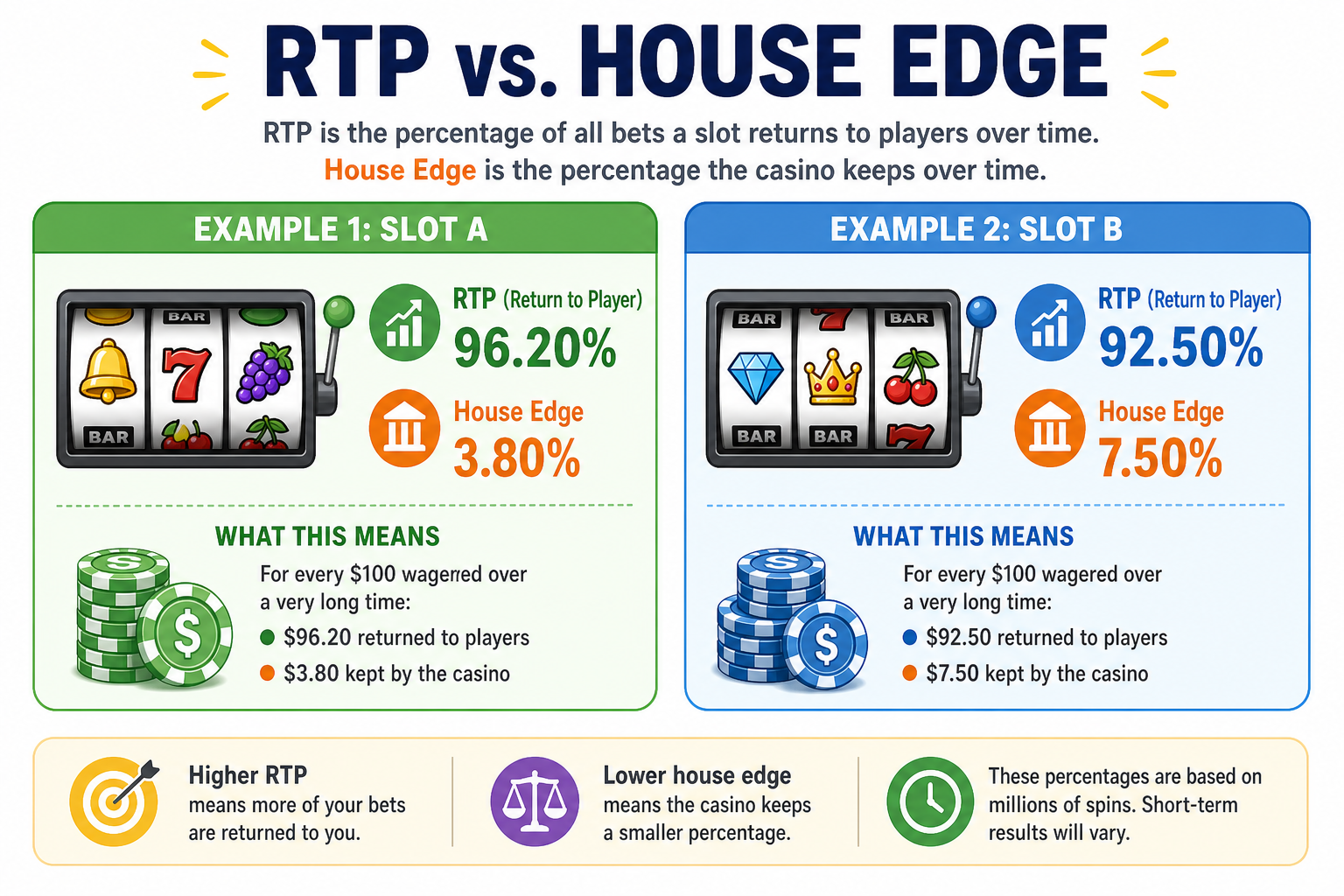
House edge is the other side of RTP.
If a slot has a 96% RTP, the long-run house edge is 4%. If a slot has a 92% RTP, the long-run house edge is 8%.
| Published RTP | House edge | What it means over the long run |
|---|---|---|
| 97% | 3% | Lower long-run cost compared with lower-RTP slots |
| 96% | 4% | Common benchmark for many modern slots |
| 92% | 8% | Higher long-run cost compared with higher-RTP slots |
A few percentage points can sound tiny. In practice, they change the long-run cost of play.
For example, if you play 100 spins at 1 Sweeps Coin per spin, you are wagering 100 Sweeps Coins. A 96% RTP game has an expected long-run cost of about 4 Sweeps Coins per 100 wagered. A 92% RTP game has an expected long-run cost of about 8 Sweeps Coins per 100 wagered.
That does not predict your exact session. It just tells you which game is mathematically more expensive over time.
What RTP Range Is Good at a Sweeps Casino?
Use this as a rough guide, not a universal rule.
| RTP range | SweepsFlow read | What it means in practice |
| 97%–99% | Generous | Rare for slots; stronger long-run value when available |
| 96%–97% | Standard / good | A healthy benchmark for many reputable slot studios |
| 94%–96% | Below average | Still playable, but not ideal if similar games are available at higher RTP |
| 92%–94% | Expensive | Higher long-run house edge; be careful with longer sessions |
| Below 92% | Serious caution | The long-run cost is high enough that most casual players should pause |
A lower RTP is not automatically “rigged.” It may simply be a lower approved version of a game. Whether you want to play that version is a separate question.
The fine print needs supervision.
Why Does My 96% RTP Slot Keep Losing?
A high RTP does not mean every session will feel smooth.
If your 96% RTP slot keeps missing, three things may be happening.
1. Your sample size is small
Most player sessions are tiny compared with the sample used to calculate RTP. A few hundred spins can look nothing like the long-run average.
2. The slot may be volatile
Two slots can both have 96% RTP and feel completely different. A low-volatility slot may pay smaller wins more often. A high-volatility slot may pay less often but offer larger possible wins.
This is where the math starts acting suspicious, but it is still normal slot design.
3. House edge still exists
Even at 96% RTP, the game is not designed to return everything wagered over time. RTP helps you compare games, but it does not remove the cost of play.
Responsible play note: Never chase losses because a game has high RTP. A cold session can stay cold. Keep play recreational, set limits before you start, and stop if play stops feeling fun.
Can the Same Slot Have Different RTP at Different Operators?
Yes. The same slot title can sometimes have different approved RTP versions at different operators.
A game may have the same name, theme, visuals, and bonus features while running a different approved math version. Operators may choose from studio-approved RTP settings depending on the provider, market, and commercial setup.
That does not automatically mean anything shady is happening. It means the version check matters.
What operators can do
Operators may choose from approved RTP versions when licensing a game, where the provider offers multiple versions.
What operators should not be able to do in a certified setup
They should not be changing RTP for one specific player, one time of day, or one short-term result if the certified game is operating as approved.
What players should do
Check the operator-specific RTP inside the game info screen. Do not rely only on generic numbers from a search result.
Where Can You Check RTP Before Playing?
Start with the source closest to the game you are actually playing.
- The in-game info screen. Look for an “i,” “info,” “help,” “rules,” or paytable button.
- The game rules or paytable. Some games list RTP near the rules, bonus description, or game information page.
- The game studio’s website. Studios may publish RTP ranges or default RTPs, but the operator may use a different approved version.
- Player communities. Reddit, Discord, and community tracking sheets can help cross-check, but they should not replace the in-game info screen.
If RTP is hard to find, note that. It does not automatically prove a problem, but clear information is always more player-friendly.
How Is RTP Calculated and Verified?
The game studio builds RTP into the slot’s math model. That model includes the paytable, hit probabilities, bonus features, volatility, and expected long-run return.
Studios may run large simulations and submit games for independent testing. Certification may review whether:
- the RNG produces statistically random results;
- the long-run return aligns with the stated math model;
- the paytable and game rules are internally consistent.
Once a certified game is locked, an operator should not be able to casually tweak the math whenever it wants without breaking the certification chain.
That is why visible game information, provider transparency, and certification details matter.
RTP vs Volatility vs Hit Frequency
RTP is only one part of the slot math picture.
| Metric | What it measures | What it tells you | What it does not tell you |
| RTP | Long-run expected return | The game’s theoretical return over huge volume | What your next session will do |
| House edge | Operator’s long-run expected margin | The expected cost of play over time | Whether you will win today |
| Hit frequency | How often any win appears | Whether wins may show up often or rarely | How large those wins will be |
| Volatility | How wins are spread out | Whether payouts tend to be smaller and frequent or larger and rarer | The exact result of your next spin |
| Max win | The listed payout ceiling | The theoretical top payout | How likely that top payout is |
A 96% RTP low-volatility slot may produce frequent smaller hits. A 96% RTP high-volatility slot may feel cold for longer and then occasionally produce larger wins.
Same RTP. Very different ride.
Practical Example: Two 96% RTP Slots Can Feel Different
Let’s say two slots both list 96% RTP.
| Slot type | RTP | Volatility | Likely session feel |
| Slot A | 96% | Low | More frequent smaller wins, fewer dramatic swings |
| Slot B | 96% | High | Longer dry stretches, with rarer larger hits possible |
Both slots have the same long-run return percentage. But they may feel completely different in a real session.
That is why RTP should not be your only filter.
Sweepstakes Casino RTP vs Real-Money Casino RTP
Sweepstakes casino RTP and real-money casino RTP are usually the same when both sites offer the same slot from the same studio at the same RTP version.
The category itself is not the magic switch.
The bigger differences usually come from:
- operator-selected RTP versions;
- bonus terms;
- playthrough rules;
- daily rewards or promotional value;
- Sweeps Coins redemption rules;
- minimum redemption amounts;
- account verification;
- state availability.
So if a sweepstakes casino and a real-money online casino both offer the same game title, from the same studio, at the same RTP version, the base math should be effectively the same.
The player experience can still feel very different because the wrapper around the game is different.
Where Sweepstakes and Real-Money RTP Actually Diverge
The base game math may be the same, but the value around the game can differ.
| Area | Sweepstakes casinos | Real-money casinos | Why it matters |
| Game math | Same studio math when the same RTP version is used | Same studio math when the same RTP version is used | Base comparison depends on version, not category |
| Bonus format | Often Gold Coin packages with bonus Sweeps Coins | Often deposit matches or bonus credits | The value structure is different |
| Playthrough | Varies by operator and promotion | Varies by operator and promotion | Higher playthrough can reduce practical value |
| Redemption / withdrawal | Sweeps Coins may be redeemable if requirements are met | Cashout rules depend on regulated site terms | Verification, minimums, and limits matter |
| No-purchase entry | Sweepstakes models usually include a no-purchase-necessary path, such as AMOE | Not usually structured as sweepstakes entries | Entry mechanics are category-specific |
AMOE means Alternative Method of Entry. If a sweepstakes casino offers AMOE, check the current rules carefully. No-purchase-necessary does not mean instant, simple, unlimited, or automatically useful.
What Is Effective RTP After Bonuses?
Effective RTP is a practical way to think about the value of play after bonuses, rewards, and terms are included.
A slot may have 96% base RTP, but your actual value can be affected by:
- bonus Sweeps Coins;
- daily rewards;
- playthrough requirements;
- eligible games;
- expiration windows;
- redemption minimums;
- promotional restrictions.
A clear, usable bonus can improve practical value. A larger-looking bonus with heavy playthrough, short deadlines, excluded games, or confusing redemption rules can be worse than it looks.
Receipts over sparkle, always.
How Should RTP Shape Your Slot Choice?
RTP can help you compare games, especially if you play longer sessions or return to the same slot often. A higher RTP means lower house edge, all else equal.
But RTP should not be your only filter.
A 97% high-volatility slot may feel rougher than a 95% low-volatility slot if you prefer steady smaller hits. The better pick depends on your budget, session length, game preference, and comfort with swings.
RTP checklist before a sweeps slot session
- Check the RTP in the in-game info screen.
- Look for volatility if the game lists it.
- Check hit frequency if available.
- Read bonus terms if you are playing with promotional Sweeps Coins.
- Check playthrough, eligible games, expiration, and redemption minimums.
- Confirm whether the operator publishes game rules clearly.
- Set a session limit before the first spin.
- Decide your stop point before emotions get involved.
What to Do Next
- Pick one slot you played recently.
- Open the in-game info screen.
- Write down the listed RTP.
- Look for volatility and hit frequency if the game provides them.
- If you play that slot often, compare the RTP at other operators where the same title appears.
- Read the current bonus and redemption terms before playing with promotional Sweeps Coins.
- Set a stop-loss and a win goal before your next session.
If you are new here, you can also create a SweepsFlow account at SweepsFlow.com/register to follow guides, updates, and community tips.
Sweeps Flow Take
RTP is useful, but it is not magic.
It tells you the long-run math, not what your next 20 minutes will look like. Use RTP to compare slots, then use volatility and hit frequency to understand the ride.
The clean answer on sweepstakes casino RTP vs real-money casino RTP is this: the base slot math is usually the same when the same studio title runs at the same RTP version. The category itself is not the magic switch.
The real work is checking the active version, reading bonus terms, understanding playthrough, and knowing how Sweeps Coins redemption works.
A higher RTP can be a better fit for some players, but it still cannot promise a winning session.
FAQs About Sweeps Casino RTP
What does RTP mean in a sweeps casino?
RTP means Return to Player. It is the long-run percentage of total wagers a slot is designed to return to players across a very large number of spins. It is not a promise for one player or one session.
Is a higher RTP slot always better?
A higher RTP means a lower house edge, which can be helpful for comparison. But it does not mean the game will be easier in one session. Volatility, hit frequency, and your session length still matter.
Does RTP guarantee I will get back 96% of what I play?
No. A 96% RTP figure is a long-run average across a very large sample. Your own session can return more, less, or nothing.
Can the same slot have different RTP at different sweepstakes casinos?
Yes. If the game studio offers multiple approved RTP versions, different operators may choose different versions. Check the in-game info screen at each operator to confirm the current RTP.
Do sweepstakes casinos have lower RTP than real-money casinos?
Not as a category-wide rule. If the same slot is offered at the same RTP version, the base math is generally the same. Differences usually come from operator-selected RTP versions, bonus terms, playthrough, and redemption rules.
Does RTP affect Sweeps Coins redemption?
RTP affects game math, not redemption rules. Redemption depends on the operator’s terms, eligibility rules, verification steps, minimums, state availability, and any playthrough requirements.
How does RTP relate to volatility?
RTP is the expected long-run return. Volatility describes how wins are distributed. Two slots can have the same RTP but feel completely different if one pays smaller wins often and the other pays larger wins less often.
Are progressive jackpot slots’ RTP different?
Often, yes. Progressive slots may have a lower base-game RTP because part of each wager helps fund the jackpot pool. When the jackpot value is included, the effective RTP can change, but the base game may feel more expensive than a comparable non-progressive slot.
Can bonuses make a lower RTP game worth playing?
Sometimes, but only if the terms are clear and usable. Check playthrough, eligible games, deadlines, and redemption rules. A bigger-looking offer is not always better in practice.
Is RTP useful for short sessions?
Yes, but only as a comparison tool. RTP helps you understand long-run game math. It does not predict a short session. Variance can create big swings, so keep sessions budgeted and treat play as entertainment.
Terms apply. Sweepstakes casino access, promotions, AMOE rules, RTP displays, game availability, and redemption options may vary by operator, state, and game provider. This article is for general education and is not legal or financial advice.
Affiliate Disclosure: Sweeps Flow may earn a commission if you visit or sign up with some operators through links on our site. Our editorial guidance stays player-first, and you should always read the current terms before playing.

Error