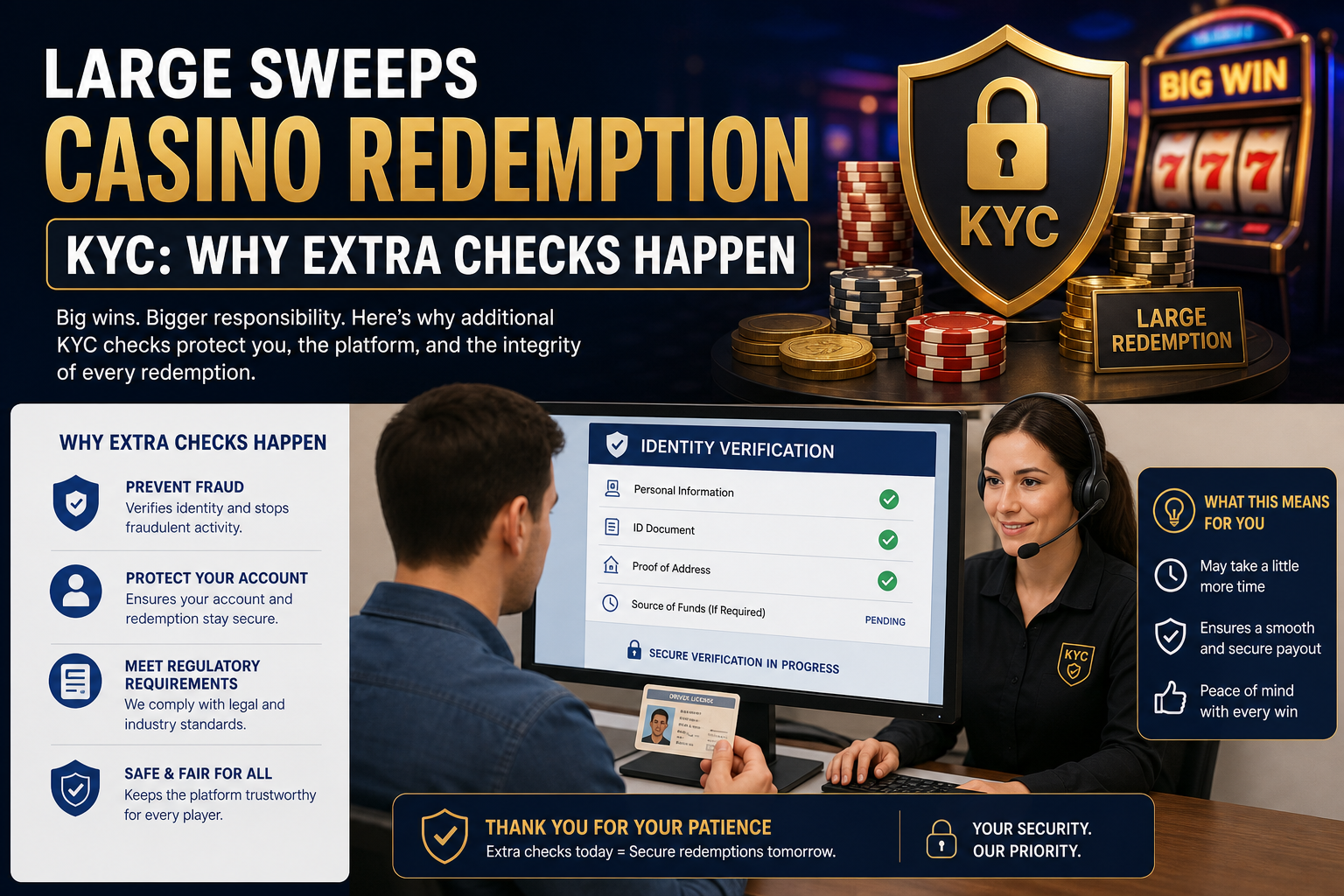
Short answer: why large sweeps casino redemption KYC happens
Large sweeps casino redemption KYC usually happens when a redemption crosses an operator’s review threshold, often around $500 or $1,000 in Sweeps Coin value. The site may ask for extra identity, address, source-of-funds, or payment ownership documents. It is a normal compliance step, not a punishment.
If your redemption suddenly gets extra questions, take a breath. The fine print needs supervision, but this part is not automatically shady. For larger redemptions, many sweepstakes casinos use enhanced KYC, also called tier-2 verification or a source-of-funds review, before approving the redemption.
Affiliate disclosure: SweepsFlow may receive compensation if you visit or sign up with some operators we mention. Our editorial view stays player-first, and terms can change. Always check the current site terms before you play or redeem. Terms apply.

Quick Take
- Enhanced KYC often appears around $500 to $1,000 in redeemed Sweeps Coin value, though exact thresholds vary by operator.
- Common document requests include government ID, proof of address, source-of-funds proof, and redemption-method ownership proof.
- Clean, complete documents can help avoid preventable delays.
- First-time large redemptions often take longer than repeat redemptions at the same site.
- A site asking for reasonable verification is usually doing the expected compliance work. A site asking you to pay more to release a redemption is a red flag.
What is enhanced KYC at a sweeps casino?
KYC means “Know Your Customer.” It is the identity-check process operators use to confirm that the person redeeming is the real account holder. Enhanced KYC is the next layer of that review.
For smaller redemptions, a site may rely on the identity check you completed earlier. For a larger redemption, the operator may ask for more proof before it approves the request. Cute bonus. Complicated personality.
In plain terms, enhanced KYC helps the operator answer four questions:
- Are you the person named on the account?
- Does your address match the account record?
- Is the redemption method yours?
- Can the operator verify the activity tied to the redemption?
This is one reason it is smart to read the redemption rules before you build up a larger Sweeps Coins balance. If you are still learning the basics, start with SweepsFlow’s beginner guide to KYC at sweepstakes casinos.
Why do large redemptions trigger extra checks?
Large redemptions trigger extra checks because operators need stronger proof before approving higher-value redemption requests. The bigger the redemption, the more likely it is to receive human review.
Some operators may review a single large redemption. Others may review your account when your total redemptions over time pass a set level. That means one redemption may clear smoothly, then the next one gets flagged for more documents because your cumulative total crossed the review line.
Thresholds can vary by operator, account history, state availability, redemption method, and internal risk rules. Access and redemption options may also vary by state. Always check the current terms where you play.
What documents do sweeps casinos ask for during large redemption KYC?
Most extra checks fall into a few normal document categories. You do not need to panic-upload your entire life. Send what the operator asks for, make it clear, and avoid covering details they need to verify.
| Document type | Common examples | Why it is requested |
|---|---|---|
| Government ID | Driver’s license, state ID, or passport. Usually front and back, with all corners visible. | Confirms your legal identity. |
| Proof of address | Utility bill, bank statement, or official letter dated recently, often within 90 days. | Confirms your current address matches the account. |
| Source-of-funds proof | Recent bank or card statement, or in some cases a written explanation if you used no-purchase-necessary options. | Helps the operator review account activity tied to the redemption. |
| Redemption-method ownership | Statement showing your name on the receiving account, or card proof with only required digits visible. | Confirms the redemption is going to the verified player. |
Protective bestie note: Do not send documents through random social media DMs or unofficial emails. Use the operator’s secure upload tool or verified support channel.
How long does enhanced KYC take?
Enhanced KYC timing varies by operator, document quality, review volume, and redemption method. The source material notes that many clean large-redemption reviews may wrap in about 3 to 10 business days, while document issues can stretch the timeline.
First-time large redemptions often take longer because the operator has not reviewed your full document set before. Repeat redemptions at the same site may be smoother after your account has already passed the extra check, but no timeline is promised.
If you are waiting and want a deeper checklist, read why your redemption may be pending.
What slows down large sweeps casino redemption KYC?
Most delays are boring, preventable document issues. This is where the math starts acting suspicious, but the fix is usually simple.
- Blurry photos: Retake the image in good light. Make sure all four corners are visible.
- Cut-off documents: Do not crop out the top, bottom, name, address, date, or ID number unless the operator tells you to cover part of it.
- Old proof of address: Use a recent document. Many operators want it dated within 90 days, though some rules may differ.
- Name mismatch: The account, ID, and redemption method should match your legal name.
- Address mismatch: If you moved, update your account before you submit documents.
- Third-party payment method: A friend’s card, partner’s account, or shared method can trigger a hard stop.
Large redemption KYC checklist before you submit
Before you file a larger redemption, build a small folder on your phone or computer. Keep it boring, clean, and organized. Your future self will be grateful.
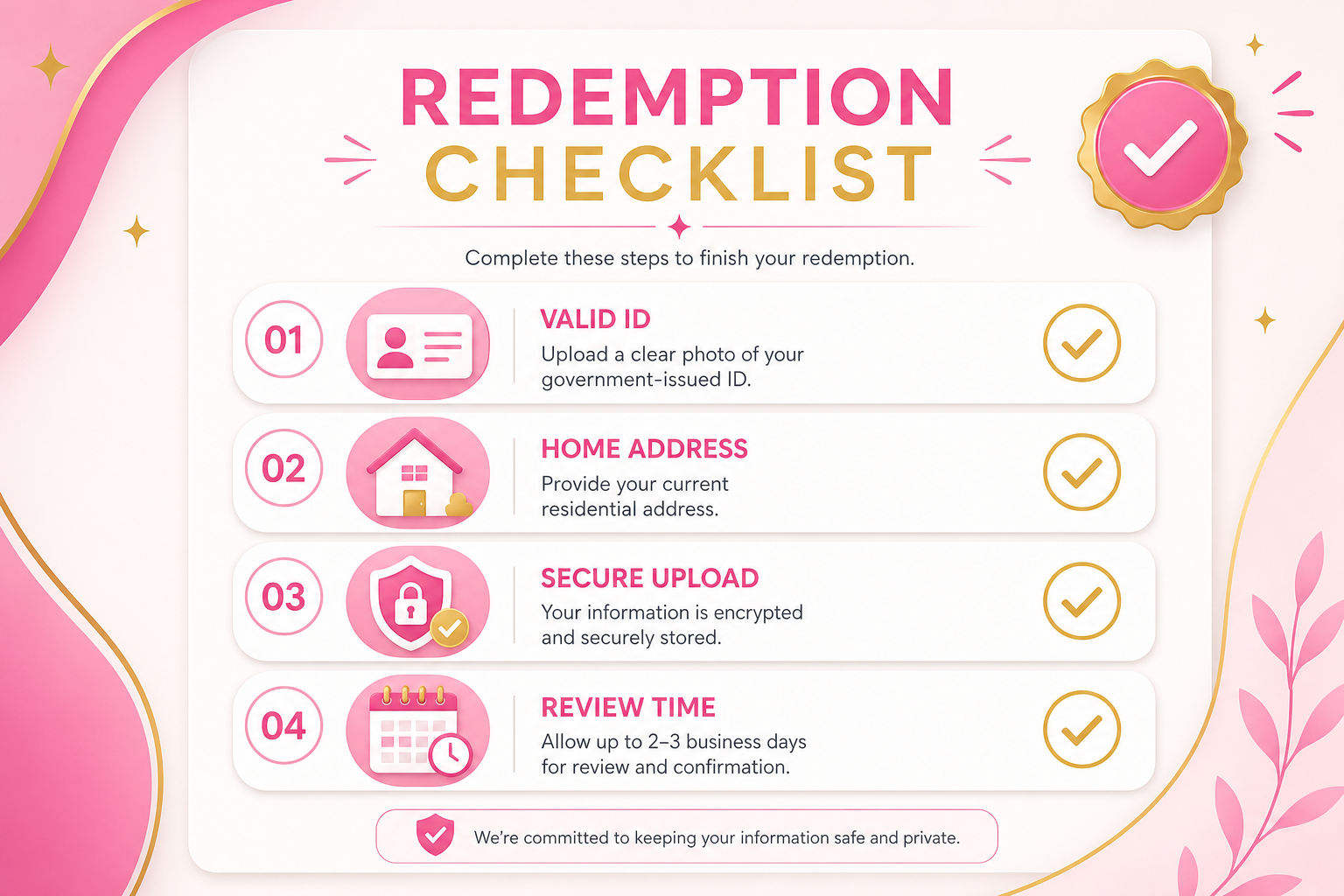
- Take a clear photo of your government ID, front and back if required.
- Download a recent proof of address, such as a bank statement or utility bill.
- Save a recent bank or card statement if the operator asks for source-of-funds proof.
- Confirm the redemption method is in your name.
- Check that your account name, date of birth, and address match your documents.
- Read the operator’s current redemption terms before submitting. Terms apply.
Responsible play reminder: Sweeps Coins redemptions should never be treated as income. Set a budget before you play, do not chase losses, and take breaks when play stops feeling fun.
What is normal vs. what is a red flag?
Extra verification is not automatically a problem. Some requests are normal. Others deserve a full stop.
| Normal verification request | Red flag request |
|---|---|
| Government ID or proof of address | Paying an extra fee to “release” a redemption |
| Proof that the receiving account belongs to you | Buying more Gold Coins as a condition to approve redemption |
| Source-of-funds review for larger activity | Being told to play through a new bonus before a pending redemption can clear |
| Secure upload through the account portal | Sending full documents through an unverified social media account |
If a request feels off, pause before sending more information. Contact official support, save screenshots, and compare the request with the site’s published terms.
Do no-purchase-necessary players still face KYC?
Yes, they can. Sweepstakes casinos commonly offer no-purchase-necessary ways to participate, including Alternative Method Of Entry (AMOE) options when available under the operator’s rules. But if you request a redemption, the operator may still need to verify your identity and eligibility.
If your activity came from no-purchase-necessary play rather than Gold Coin purchases, the operator may ask for a plain explanation or other account review documents. Keep your reply simple and truthful. Do not over-explain or send more than requested.
What to do next
If you are planning a larger redemption, do this before you click submit:
- Review the operator’s current redemption rules and state restrictions.
- Make sure your profile details match your ID and proof of address.
- Prepare clear document photos in advance.
- Use only a redemption method that belongs to you.
- Read what to check before your first sweeps casino redemption.
If you are new to SweepsFlow, you can also join the community here for more beginner-friendly guides and player-protective tips.
SweepsFlow Take
Large sweeps casino redemption KYC is not the villain. It is usually the operator doing the extra review that comes with bigger redemption requests. The smoother move is to prepare your documents early, keep your account details clean, and avoid any site that asks you to pay more or make extra Gold Coin purchases to release a redemption.
Have fun, read the terms, and keep your play inside a budget that still lets real life stay cute.
FAQs about large sweeps casino redemption KYC
Will every sweeps casino ask for enhanced KYC on a large redemption?
Many sweepstakes casinos use enhanced KYC for larger redemptions, but the exact threshold and process vary by operator. Check the current redemption terms before you play or submit a request.
Can I complete enhanced KYC before I request a large redemption?
Some operators may allow extra verification before redemption, while others only start the review after a redemption request triggers it. Look inside your account settings or ask official support through the site’s verified channel.
What if my proof of address does not match my ID?
Update your account information first, then use a current proof of address that matches where you live. If the operator asks for an explanation, keep it clear and honest.
Is it safe to upload KYC documents?
Use the operator’s secure upload portal or verified support channel only. Do not send sensitive documents through random DMs, unofficial email addresses, or public posts.
Why did my last redemption clear but this one triggered KYC?
Your account may have crossed a larger single-redemption or cumulative-redemption review threshold. Some operators review total redemption activity over time, not just one request.

Error