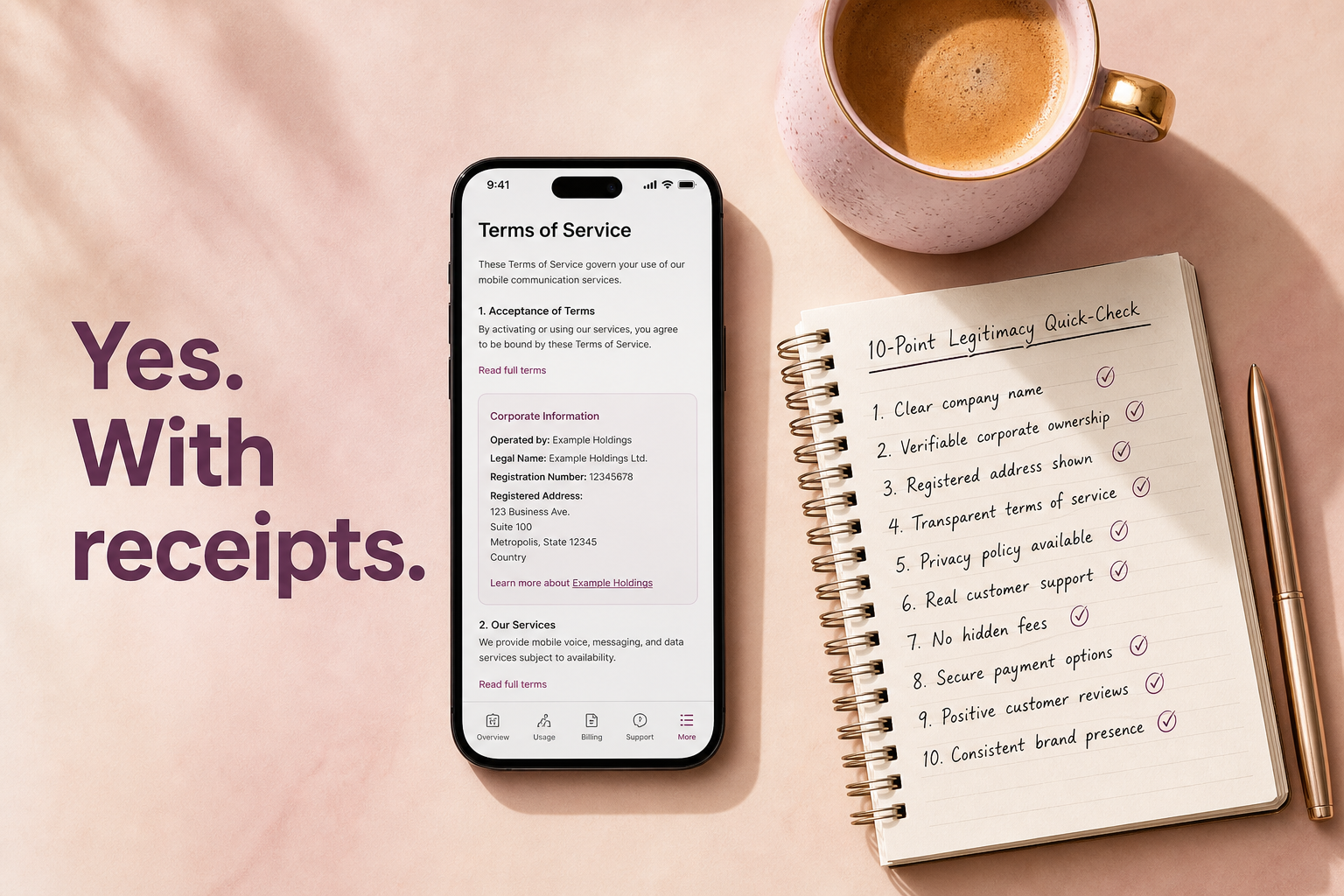
Short Answer: Some sweepstakes casinos are established businesses with published rules and working prize-redemption systems, but the label “sweepstakes casino” does not prove that a site is legal in your state or trustworthy with your account. Check state eligibility, the company behind the site, the current sweepstakes rules, no-purchase entry method, verification requirements, and redemption terms before joining.
By Maya Reed, Sweeps Flow Editorial | Updated September 2026
The word “legit” can mean several things when you are looking at a sweepstakes casino.
A site can belong to a real company and still be unavailable where you live. It can publish a no-purchase entry method and still have redemption terms you do not like. A familiar brand name also does not replace checking the current state restrictions.
This guide separates those questions so you can decide what you are dealing with before creating an account or spending money.

Quick Take
- A real company and a legally available operator are not the same thing.
- State rules and operator restrictions can change, so check your location before creating an account.
- A no-purchase entry method is an important part of a sweepstakes promotion, but it does not prove the entire site is trustworthy.
- Find the legal entity behind the brand, not only the casino name.
- Read redemption and verification rules before you care about a large Sweeps Coin balance.
- Clear terms, accessible support, responsible-play tools, and consistent policies are useful trust signals.
- A well-known brand still needs the same checks as a newer one.
What does “legit” mean for a sweepstakes casino?
Before deciding whether a site is legitimate, separate the question into three parts.
| Question | What you are checking | Where to look |
|---|---|---|
| Is this a real operator? | The legal company, contact information, privacy policy, and terms | Footer, Terms of Use, Privacy Policy, About or Contact pages |
| Can the operator serve me where I live? | State exclusions, location rules, and current legal restrictions | Current terms, eligibility rules, state regulator or attorney general |
| Do I understand what happens to my money and prizes? | Coin rules, promotions, KYC, redemption minimums, payment methods, and account restrictions | Sweepstakes rules, promo terms, redemption pages, help center |
A good result in one column does not answer the others.
How do sweepstakes casinos usually work?
Many sweepstakes casinos use separate virtual currencies for social play and promotional sweepstakes play. The names and rules vary by operator.
| Feature | Typical purpose | What to check |
|---|---|---|
| Gold Coins | Social casino-style play | Whether the Gold Coin balance has any redemption value |
| Sweeps Coins or similar promotional currency | Sweepstakes-style promotional play | Eligible play, expiration, redemption minimums, verification, and state eligibility |
| No-purchase entry method | A way to participate in the sweepstakes promotion without buying a package | Current instructions, eligibility, limits, and deadlines |
| KYC | Identity and eligibility checks | When verification happens and what documents may be required |
| Prize redemption | Requesting an eligible prize | Minimums, account requirements, methods, timing, and restrictions |
These features explain the operator’s model. They do not replace checking whether that model is permitted where you live.
A no-purchase method is important, but it is not a trust stamp
Sweepstakes promotions should explain how eligible participants can enter without making a purchase.
Operators often call this an Alternative Method of Entry, or AMOE. The process may use postal mail, an online method, or another route described in the official rules.
A visible AMOE page is useful because it gives you something concrete to review. It does not prove that the operator is legal in every state, financially reliable, fair in every dispute, or good at processing redemptions.
Check the no-purchase method as one part of the larger review.
What makes a sweepstakes casino easier to trust?
1. You can identify the company behind it
Open the Terms of Use and Privacy Policy and find the exact legal entity.
Look for:
- operating company
- sponsor or promoter
- registered or business address
- support contact
- payment agent, if listed
- affiliated or related companies
A brand logo tells you what the site is called. The legal entity tells you who you are dealing with.
2. The terms are current and easy to find
Check the effective date or version number.
The site should make it possible to find the account rules, state restrictions, promotional rules, redemption requirements, privacy policy, and dispute terms without relying on a social post or affiliate review.
Terms can change. A page you read six months ago may no longer describe the account you can open today.
3. State eligibility is stated clearly
Look for an excluded-state or eligible-state section before registering.
Do not assume that a site is available simply because the homepage loads where you live.
Do not use a VPN or location workaround to bypass a restriction.
4. Redemption rules exist before you need them
Read the redemption section before you build a Sweeps Coin balance.
Look for:
- what makes Sweeps Coins eligible
- minimum redemption amount
- identity requirements
- available prize methods
- payment-method ownership rules
- processing language
- account restrictions that can affect redemption
If you want to compare published redemption requirements across operators, use the Sweeps Redemption Index.
A bonus is easier to advertise than a redemption process. Read both.
5. Verification rules make sense
KYC timing varies. An operator may verify some information during registration, request documents later, or require additional checks before redemption.
The useful question is whether the process is explained and handled through official channels.
Do not send identity documents through social-media messages, unofficial email addresses, or links you cannot verify.
6. Support exists before there is a problem
Find the help center and support contact before you need them.
Check whether the site explains common issues such as verification, account recovery, state eligibility, purchases, and redemption.
Support availability does not guarantee a good outcome, but a site with no clear support route gives you fewer options when something goes wrong.
How Sweeps Flow evaluates operators
Sweeps Flow uses a repeatable review framework rather than relying on brand recognition or promotional claims. Our Sweeps Flow Vibe Check methodology explains the factors we use when reviewing operator transparency, redemption terms, account rules, support, and player protections.
Checks experienced players make before they trust a site
Basic checks tell you whether the site looks organized. A few additional checks can tell you much more.
Search the legal company name, not only the casino brand
Copy the legal entity from the terms and search that name separately.
The same company may operate several brands. Looking at the legal entity can reveal related sites, policy history, regulatory actions, and account relationships that are harder to find by searching the logo name alone.
Check the terms version and recent change history
If the operator publishes version numbers or effective dates, look at them.
Pay particular attention to recent changes involving:
- excluded states
- account eligibility
- Sweeps Coin rules
- redemption requirements
- AMOE procedures
- dispute provisions
A review written last year cannot tell you what changed last month.
Search your state before you search for bonus codes
Search the operator or legal company together with your state and terms such as:
- attorney general
- gaming commission
- cease and desist
- settlement
- prohibited
- excluded state
Do this before reading affiliate rankings or promotional pages.
A regulator or current operator restriction tells you more about availability than a bonus page does.
Search inside the terms instead of reading from the top
Use your browser’s Find function and search for:
redeemverificationminimumexcludedsuspendterminatechargebackarbitrationhouseholdduplicateaffiliate
You can learn a surprising amount about an account in a few minutes.
Check related brands before claiming a welcome offer
Two casinos with different names may share an operating company, payment agent, platform, or related-account rules.
If you already have an account with a related brand, read the new promotion terms before assuming you qualify as a new customer.
Save the terms that matter when you act
If you claim a promotion or make a purchase, keep a dated screenshot or confirmation showing the offer and the terms you relied on.
Do the same for a redemption request.
You are creating a record, not preparing for a fight. It is easier to solve a disagreement when you know what the page said at the time.
Ask support one specific question before spending
If an important rule is unclear, ask official support before making a purchase.
A useful question is specific:
“Does this promotional Sweeps Coin balance have any eligible-play requirement before redemption?”
Save the answer with the date.
Sweepstakes casino red flags to watch
One warning sign does not automatically prove a site is fraudulent. Several unresolved issues should make you more cautious.
| Red flag | Why it matters |
|---|---|
| You cannot identify the operating company | It is harder to know who controls the account or handles disputes |
| Terms or sweepstakes rules are missing | You cannot verify the rules you are agreeing to |
| State eligibility is unclear | You may create an account that should not be available to you |
| No understandable no-purchase entry instructions | The sweepstakes structure is difficult to verify |
| Redemption requirements appear only after you try to redeem | Important conditions should be reviewable earlier |
| Marketing suggests prize redemption, but the terms say no prizes of real-world value are available | The marketing and legal terms may be describing different products or promotions. Resolve the contradiction before creating an account or spending money. |
| Support asks for sensitive documents through unofficial channels | Identity information should be handled through a process you can verify |
| Promotions use heavy urgency while important terms are hard to find | Pressure makes it easier to overlook restrictions |
| Similar unresolved redemption complaints appear repeatedly | A repeated pattern deserves more attention than one isolated complaint |
| The company name changes between important policy pages without explanation | You need to understand which entity operates, sponsors, or processes the account |
Responsible-play controls are also worth checking. Their absence does not automatically prove a site is fake, but limits, timeouts, self-exclusion, and clear player-safety information are useful quality signals.
Are sweepstakes casinos legal in every state?
No.
State treatment differs, and the legal picture can change. An operator may also choose to leave a state even when a new statute has not recently taken effect.
Check both:
- the operator’s current excluded-state or eligibility list
- current information from your state regulator, attorney general, or other official source when legality is uncertain
Do not assume that an article, app-store listing, affiliate page, or working signup button proves current eligibility.
This article provides general information and is not legal advice.
Trust signals that do not prove legitimacy by themselves
Several things can look reassuring without answering the full question.
A recognizable brand name: A familiar operator can still be unavailable in your state.
AMOE instructions: Useful to review, but they do not establish state legality or guarantee redemption.
KYC: Identity verification is normal at many operators. It does not prove game fairness or guarantee approval of a prize request.
Popular game providers: Well-known game names tell you something about the content offered. They do not tell you how the operator handles your account or redemption.
Social followers and influencer promotion: Popularity is marketing evidence, not regulatory evidence.
Affiliate rankings: Use reviews for comparison, then verify important claims in current operator and official sources.

Sweepstakes casinos and licensed real-money casinos are different
Do not assume a sweepstakes casino has the same regulatory status as a state-licensed real-money online casino.
State-regulated real-money casinos operate under the licensing and oversight system of the jurisdictions where they are authorized.
Sweepstakes casino operators use a different promotional model and may not be subject to the same state casino licensing, auditing, or consumer-protection structure.
The legal treatment of that model depends on the state.
Offshore real-money casinos are another category again. If a site does not clearly explain what it is offering and which company operates it, find that answer before creating an account.
Responsible play
A trustworthy-looking site does not change the math of casino-style games.
Set spending and session limits before you play. Treat Gold Coin purchases as entertainment spending, and do not treat Sweeps Coin redemption as income or money you expect to receive.
Do not increase spending to recover losses or reach a redemption minimum.
If play becomes difficult to control, use available timeout or self-exclusion tools and consider outside support.
What to do before joining
Run these checks in this order:
- Confirm current state eligibility.
- Find the legal company in the terms.
- Check the effective date of the terms and sweepstakes rules.
- Read the no-purchase entry instructions.
- Read redemption and KYC requirements.
- Find the official support and privacy pages.
- Search the legal entity and your state for recent regulatory action.
- Save any promotion terms you decide to use.
- Set your spending and session limits before making a purchase.
For more detail, read:
- How to Spot a Fake Sweepstakes Casino: 10 Red Flags
- Sweeps Casino Redemption Guide
- Sweeps Redemption Index
- What Is AMOE at a Sweeps Casino?
- Sweeps Casino AMOE Mail-In Guide
- First-Time Sweeps Casino Signup Guide
Sweeps Flow Take
Some sweepstakes casinos are real businesses with published rules, customer support, and working prize-redemption systems. That still leaves separate questions about state eligibility, account rules, and how the operator handles redemption.
Check the company behind the brand, your state eligibility, and the rules that affect your money before treating a familiar logo as a trust signal.
A site that makes those answers easy to find gives you more information to work with. If you cannot get clear answers before joining, there is no reason to rush.
FAQs about sweepstakes casino legitimacy
Are sweepstakes casinos legal in the U.S.?
There is no single nationwide answer that makes every sweepstakes casino legal everywhere. State law, regulatory action, and operator exclusions vary. Check the current rules for the operator and official information for your state.
Are sweepstakes casinos licensed like real-money online casinos?
Do not assume so. Sweepstakes casinos generally use a different promotional model from state-licensed real-money online casinos. The regulatory treatment and consumer protections can differ by state.
Does AMOE mean a sweepstakes casino is legitimate?
No. A clear no-purchase entry process is useful information, but it is only one part of the review. You should still check state eligibility, ownership, redemption terms, verification, and support.
Can Sweeps Coins be redeemed for prizes?
Eligible prizes may be redeemable through Sweeps Coin promotional play when the operator’s requirements are met. The exact rules, minimums, verification requirements, and prize methods vary.
Why do sweepstakes casinos ask for ID?
Operators may use identity checks to confirm age, identity, location, account ownership, payment information, or prize eligibility. The timing and documents depend on the operator.
How do I find out who owns a sweepstakes casino?
Open the Terms of Use, sweepstakes rules, and Privacy Policy. Search for phrases such as “operated by,” “sponsor,” “promoter,” “company,” and “registered office.” Use the legal company name when researching the operator.
What is the biggest red flag?
There is no single red flag that answers every case. Difficulty identifying the company, missing rules, unclear state eligibility, hidden redemption requirements, and requests for sensitive information through unofficial channels all deserve immediate attention.
Does a well-known sweepstakes casino automatically mean it is safe in my state?
No. Brand recognition does not establish current state eligibility. Check the operator’s current excluded-state list and official state information before registering.
Compliance note: State laws, operator availability, eligibility requirements, promotions, AMOE methods, verification, and redemption rules can change. Check current official terms and state information. This article provides general information and is not legal advice.
Affiliate disclosure: Sweeps Flow may earn a commission if you visit or register with some operators through links on our site. Compensation does not determine our editorial conclusions or replace verification of current operator terms.

Error