
Short Answer: A mail-in AMOE request is one way some sweepstakes casino operators let eligible players participate without making a purchase. The exact card, envelope, wording, account details, codes, limits, and mailing instructions depend on the operator. Check the current official rules every time you prepare a request.
Author: Maya Reed, Sweeps Flow Editorial | Updated September 2026
Mail-in AMOE requests can look simple until you compare the rules from one operator to another. One site may ask for a postcard and request code. Another may specify an envelope size, ink color, exact statement, or mailing deadline.
This guide focuses on the postal side of AMOE: how to read the current instructions, prepare your request, check it before mailing, and keep a record afterward.
If you are looking for a broader explanation of AMOE and other no-purchase methods, start with our What Is AMOE at a Sweeps Casino? guide.
Quick Take
- AMOE means Alternative Method of Entry, a no-purchase route described in a sweepstakes promotion’s official rules.
- This guide covers mail-in AMOE requests. AMOE itself is not always limited to postal mail.
- There is no universal AMOE letter or postcard format.
- Check the current rules for the mailing address, card or paper size, wording, account information, request codes, submission limits, and mailing instructions.
- Only provide the personal information the official process asks for.
- Keep a record of what you mailed and the date you sent it.
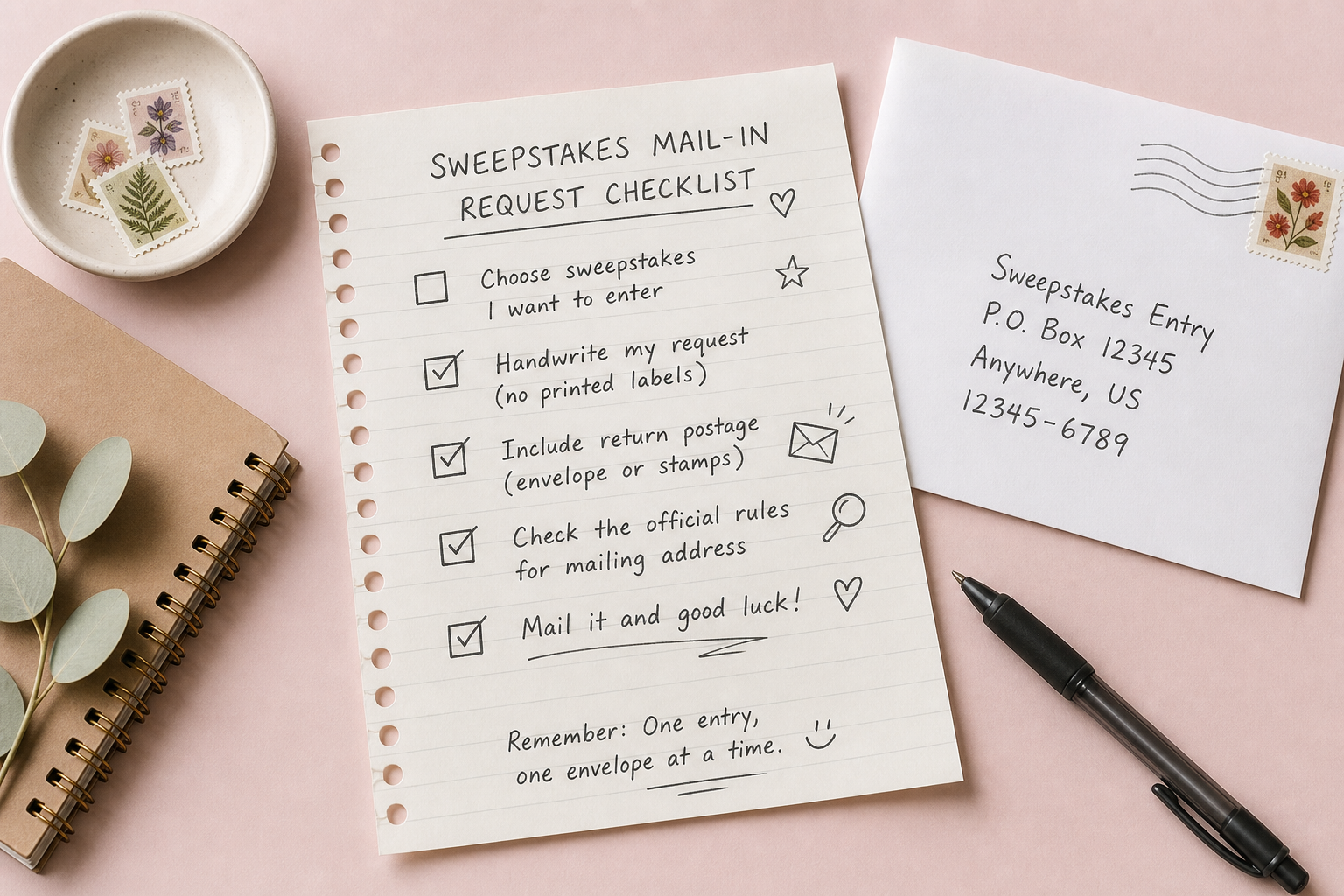
What is a mail-in AMOE request?
A mail-in AMOE request is a postal no-purchase entry method offered under some sweepstakes casino rules. An eligible participant follows the operator’s instructions and mails the required request card, postcard, paper, or other listed format.
AMOE is broader than mail. Depending on the operator or promotion, the no-purchase process may use postal mail, an online method, or another route described in the official rules.
Sweeps Coins are not cash. If an operator credits Sweeps Coins after a valid AMOE request, those coins are used under that operator’s promotional-play rules. Prize eligibility can still depend on eligible play, account verification, location, redemption minimums, and other current terms.
A published AMOE method also does not tell you everything you need to know about an operator. State availability, redemption rules, account requirements, and other terms still need to be checked separately.
How to prepare a sweeps casino AMOE mail-in request
The details vary by operator, but the safest process is consistent: build your request from the current official rules instead of copying an old template.
Step 1: Find the current official rules
Open the operator’s current sweepstakes rules, promotional rules, or AMOE instructions.
Look for terms such as:
- Alternative Method of Entry
- Mail-In Entry
- Postal Request
- No Purchase Necessary
- Request Card or Entry Card
Use the operator’s own website or account area. An old screenshot, forum post, social comment, or saved template may contain an outdated address or requirement.
Step 2: Copy the requirements into a checklist
Read the entire AMOE section before writing anything.
Check for:
- mailing address
- card or paper size
- envelope size
- handwritten or typed requirements
- allowed ink color
- exact wording or statements
- account information
- residential or return address
- email or account identifier
- request code, if required
- signature or date, if required
- placement of information on the card or envelope
- number of requests allowed per envelope
- submission or frequency limits
- postmark, receipt, or code-expiration deadlines
- required postal service or mailing method
A requirement from one casino should not be carried over to another unless both operators say the same thing in their current rules.
Step 3: Prepare the request exactly as instructed
Write or print only what the operator asks for.
If the rules provide an exact statement, copy it exactly. If they tell you where a code, address, signature, or other detail belongs, follow that placement.
Do not add a date of birth, ID number, Social Security number, or other sensitive information unless the published process specifically requires it.
Step 4: Prepare the envelope
Check the mailing address again before sealing the envelope.
Review any requirements covering the return address, envelope size, handwritten information, request code, postage, or other markings.
If the rules allow only one request per envelope, do not combine requests to save postage.
Step 5: Check the finished request
Compare the completed request and envelope against the current rules line by line.
Look for small mismatches such as:
- an old mailing address
- a missing or incorrect request code
- missing required wording
- the wrong card or envelope size
- difficult-to-read handwriting
- account information that does not match
- information written in the wrong place
- too many requests in one envelope
Mail it after the finished request matches the instructions.
Step 6: Record the mailing date
Keep a simple record of the operator, mailing date, and any non-sensitive request code or reference information you may need later.
You do not need to create a file full of identity documents or other sensitive personal information to track AMOE mail.
What information might an AMOE request require?
There is no standard list that applies to every operator. Use the table below to know what to look for in the current rules.
| Item to check | What to verify |
|---|---|
| Legal name | Use the name required by the operator and make sure it matches your account when instructed. |
| Account email or ID | Copy it carefully so the request can be matched to the correct account. |
| Mailing or residential address | Use the address required by the current rules. |
| Request card or paper | Check the required size, material, and whether it must be handwritten. |
| Exact statement | Copy required wording exactly instead of paraphrasing it. |
| Request code | If a unique code is required, check where to get it, where to write it, and when it expires. |
| Signature and date | Include these only when the rules require them. |
| Envelope | Check the size, return address, mailing address, markings, and any one-request-per-envelope rule. |
Only include information requested by the operator’s official AMOE process.
Can you use a generic AMOE letter template?
There is no universal mail-ready AMOE template that works across sweepstakes casinos.
A generic template can help you organize the requirements, but copying one directly can cause problems if the operator requires a postcard instead of a letter, exact wording, a unique code, a specific ink color, or information in a particular position.
Use the current rules as your template.
Before you write, fill out a worksheet like this:
Operator:
[Name]
Rules checked on:
[Date]
Current mailing address:
[Copy from official rules]
Required request format:
[Postcard, request card, paper, other]
Card or paper size:
[Copy from official rules]
Envelope requirements:
[Copy from official rules]
Handwritten or typed:
[Copy from official rules]
Ink requirements:
[Copy from official rules]
Account information required:
[Copy from official rules]
Exact statement required:
[Copy exactly from official rules]
Request code required:
[Yes / No and current instructions]
Signature or date required:
[Copy from official rules]
Submission limit:
[Copy from official rules]
Deadline or code expiration:
[Copy from official rules]
This worksheet is for organizing the instructions. It is not the request you mail.
AMOE habits that can prevent wasted mail
Once you understand the operator’s rules, a few simple habits can make mail-in AMOE easier to track and less prone to avoidable mistakes. These are process habits, not shortcuts around the rules.
- Save the rule version you used. Note the date you checked the operator’s AMOE rules so you know which instructions you followed if the page changes later.
- Generate request codes last. If an operator uses codes with an expiration period, prepare everything else first and create the code close to mailing.
- Use an operator-specific checklist. Do not keep one universal AMOE template. Track card size, ink, wording, envelope rules, limits, and codes separately for each site.
- Track mailed, credited, and rejected requests. A simple log can show whether a delay is postal, processing-related, or tied to a recurring formatting mistake. Your existing no-purchase content already recommends tracking AMOE limits, dates sent, credits received, and rejected entries.
- Check redemption rules before spending time on AMOE. A no-purchase entry may be valid, but that does not automatically mean the resulting Sweeps Coins are immediately redeemable. Your current guide already correctly separates AMOE crediting from prize eligibility.
- Recheck the rules before every new batch. An address, code process, wording requirement, or submission limit can change. A checklist from last month is not automatically current.
Why might a mail-in AMOE request not be credited?
A missing credit does not always mean the request was formally rejected. Postal delivery and operator processing can also affect when a request appears in your account.
If something seems wrong, compare what you mailed with the rules that applied when you sent it.
| Possible issue | What to check |
|---|---|
| Outdated mailing address | Compare the address you used with the operator’s current official rules. |
| Wrong card or envelope format | Recheck the size, paper type, handwriting, ink, and envelope requirements. |
| Missing or incorrect wording | Confirm that any required statement was copied exactly. |
| Request-code problem | Check that the code was correct, valid when required, and placed where instructed. |
| Account details do not match | Compare the request with the account information required by the rules. |
| Submission limit exceeded | Check limits on requests, envelopes, frequency, or promotional periods. |
| Request is still being processed | Check postal delivery and any published processing timeline before assuming rejection. |
If you contact support, include the date you mailed the request and the email associated with your account. Use the operator’s secure process if support asks for identity documents.

How long does mail-in AMOE take?
There is no useful processing time that applies to every sweeps casino.
The total wait may include postal delivery, the operator’s processing queue, account matching, request-code validation, and the operator’s own crediting schedule.
Use the timing published in the current rules or help center when one is available. If no timeline is listed, keep the mailing date in your records and ask official support about its current process.
A timeline from another casino is not a reliable estimate for yours.
What happens after AMOE Sweeps Coins are credited?
Receiving AMOE Sweeps Coins does not turn them into cash.
Once the coins appear in your account, check the operator’s rules for eligible play, redemption requirements, minimums, identity verification, and any restrictions that apply to the balance.
Do not assume that receiving Sweeps Coins means a prize can be redeemed immediately.
For the full process, read our Sweeps Casino Redemption guide.
Is mail-in AMOE worth using?
That depends on how much time you want to spend managing the process.
Mail-in AMOE removes the purchase requirement, but you still have postage, preparation, and recordkeeping to consider. Some players may find that worthwhile. Others may prefer daily rewards or another no-purchase method when the operator offers one.
The important part is knowing what you are signing up for before you start writing cards and buying stamps.
AMOE Sweeps Coins are not income, and receiving them does not change the uncertainty of game results or prize eligibility.
Responsible play note: Set spending and session limits before you play. Free or promotional Sweeps Coins are still used in games with uncertain outcomes. Do not use them as a reason to extend a session or chase losses.
AMOE checklist before you seal the envelope
- I checked the operator’s current official rules.
- I copied the mailing address from those rules.
- My request uses the required card or paper size.
- My envelope follows the listed requirements.
- My handwriting, ink, and formatting match the instructions.
- My account information matches the details required by the operator.
- I included the exact statement or request code if required.
- I followed any one-request-per-envelope rule.
- I checked submission limits and deadlines.
- I kept a record of the mailing date.
If you are unsure about one of these items, check the official rules again before mailing.
What to do next
For a broader explanation of no-purchase entry methods, read What Is AMOE at a Sweeps Casino?
If you are ready to prepare a postal request, open the operator’s current rules and build your checklist from that page before writing anything.
You may also want to read:
- Free Sweeps Coins With No Purchase
- Gold Coins vs Sweeps Coins
- How Sweeps Casino Redemption Works
- What Is a Playthrough Requirement?
Sweeps Flow Take
Mail-in AMOE is a process where small details matter. Work from the operator’s current rules each time instead of saving one letter template and reusing it.
Addresses, codes, wording, and formats can change. Check the instructions before writing, compare the finished request with the rules before mailing, and keep the mailing date for your records.
FAQs About Sweeps Casino AMOE Mail-In Requests
What does AMOE mean?
AMOE means Alternative Method of Entry. It is a no-purchase way to participate in a sweepstakes promotion under the operator’s official rules. This guide focuses on postal AMOE requests.
Is AMOE always done by mail?
No. The available no-purchase process depends on the operator and promotion. Some use postal requests, while others may describe a different free-entry method in their rules.
Can I use the same AMOE letter for several casinos?
There is no universal letter that works across operators. Each site can use different addresses, formats, wording, codes, limits, and account requirements. Prepare each request from that operator’s current rules.
Do AMOE requests always get credited?
No. A request may be invalid if it does not meet the operator’s current requirements. Postal delays can also affect timing. Check the rules and any published processing information before assuming a request was rejected.
How many Sweeps Coins do you get from a mail-in AMOE request?
There is no universal amount. The number of Sweeps Coins or entries associated with a valid request depends on the operator’s current rules and can change. Check the official rules before deciding whether the time and postage are worth it for you.
Can I mail several AMOE requests in one envelope?
Only if the current rules allow it. Some operators require a separate envelope for each request. Do not combine entries unless the instructions clearly permit it.
Do I need a request code?
Some operators use a unique code for postal requests. Others may use a different process. If a code is required, check how to generate it, where it must appear, and whether it has an expiration period.
Is mail-in AMOE available in every state?
No. A mail-in entry method does not override operator or state eligibility rules. Check the current rules for your location before registering or mailing a request.
Compliance note: AMOE methods, eligibility, state availability, account requirements, promotional rules, and prize-redemption conditions vary by operator. Use the current official rules before preparing a request. This article provides general information and is not legal advice.
Affiliate disclosure: Sweeps Flow may earn a commission if you visit or register with some operators through links on our site. Compensation does not change our editorial standards or responsible-play guidance.

Error