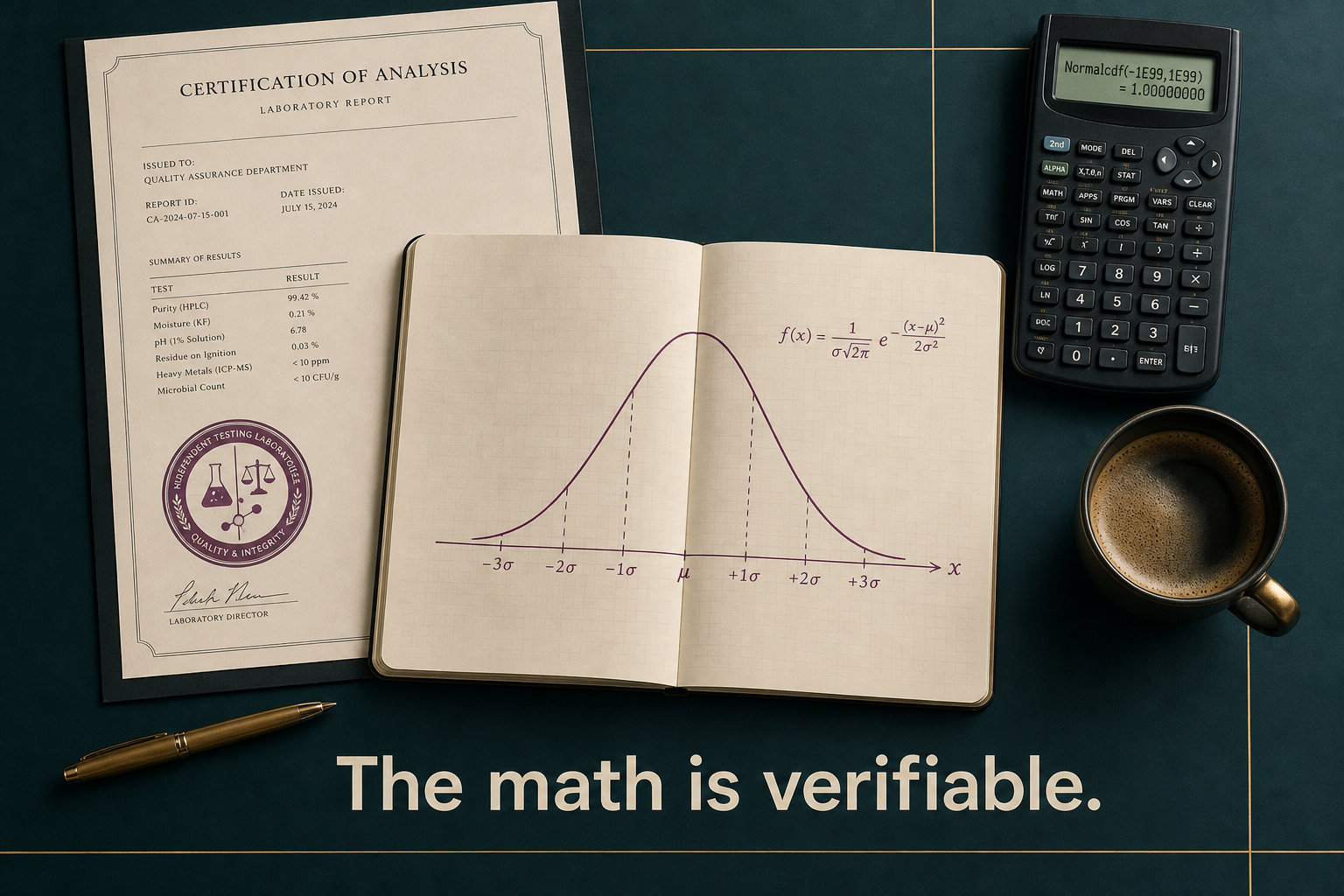
Short Answer: An RNG, or Random Number Generator, produces the random selections used by an RNG-based game. The game's rules and mathematical model then turn those selections into outcomes such as reel positions, card results, or bonus events.
Properly tested RNG implementations are checked for qualities such as unpredictability, intended distribution, and independence between draws. A losing streak does not make the next independent result due.
By Miles Carter, Sweeps Flow Editorial | Updated September 2026
A slot can lose ten times in a row without building up a secret obligation to apologize on spin eleven. That is the part of RNG math our brains tend to dislike.
RNG explains how random selections are produced, while the game's math determines what those selections mean. Understanding the difference makes it easier to separate real fairness questions from a session that was simply unpleasant.
Quick Take
- RNG means Random Number Generator.
- The RNG produces random selections. The game's math maps those selections to outcomes and payouts.
- Online games may use software-based pseudorandom generators, hardware RNGs, or other tested implementations.
- Previous independent results do not make the next result more likely to win.
- Some games have disclosed features that carry progress between spins, so “the slot remembers nothing” is too broad.
- RNG certification, game certification, RTP testing, and platform testing are different scopes.
- A certificate only proves what its testing scope actually covers.
- RNG and RTP answer different questions.
What is sweeps casino RNG?
RNG means Random Number Generator. In an RNG-based game, the RNG produces random selections that the game software uses when determining an outcome.
For a slot, those selections may be mapped to reel positions, symbols, bonus events, or other random elements. RNG-based table games can use the same general concept for cards, dice, wheels, or another defined event.
The RNG is only one part of the system. Game rules, paytables, probability models, and other logic determine how random selections translate into actual results.
How does RNG decide a slot result?
The exact implementation varies by game, but a simplified slot sequence looks like this:
- You start the game event.
- The game makes one or more calls to its RNG.
- Random selections are scaled or mapped according to the game's rules and mathematical model.
- The game evaluates symbols, features, and any resulting payout.
- The interface displays the outcome.
GLI's interactive-gaming standard treats RNG selection, scaling and mapping, game evaluation, and the game's rules as related but distinct parts of the system. It also requires mapping and scaling methods to avoid introducing unintended bias.
This is why a game can be random while still having a defined RTP. The RNG supplies random selections, while the mathematical model determines the long-run value attached to the possible results.
Is casino RNG really random?
Many software gaming systems use a pseudorandom number generator, or PRNG. A PRNG uses an algorithm and seed data to create a sequence designed to be unpredictable for practical gaming use.
Hardware RNGs also exist, and some testing labs evaluate both software and hardware implementations. iTech Labs, for example, says its RNG testing can include source-code evaluation plus testing of raw, scaled, or shuffled outputs for PRNG and hardware systems.
“Pseudorandom” does not mean fake. What matters is whether the implementation is properly designed, seeded, mapped, tested, and resistant to prediction.
Does a slot remember previous spins?
For an independent RNG draw, previous wins and losses do not make the next result more or less likely simply because they happened first. GLI-19 requires independence between draws except where the game design specifically provides otherwise.
That last part matters because some games include persistent features. A collection meter, held symbol, progressive state, or other disclosed mechanic may carry progress from one event to another.
The game feature can remember progress without the RNG deciding that your account has been losing for too long. The software can keep track of a meter; it is not keeping an emotional diary about your Tuesday night.
Why doesn't a losing streak make a slot due?
Independent random events do not become more likely to produce the opposite result because of what happened previously. A long losing streak can feel as though it has created pressure for a win, but the next independent selection does not know how annoying the previous ten were.
This mistaken expectation is often called the gambler's fallacy. It is one reason a cold session can tempt players to continue longer than they planned.
Do not extend a session because the game feels due. Randomness is under no obligation to restore the mood.
Who tests casino RNG software?
Independent testing laboratories can evaluate RNG systems, game mathematics, platforms, integrations, and other components. The testing assignment determines what the resulting certificate actually covers.
| Testing lab | Publicly described testing | What to check |
|---|---|---|
| Gaming Laboratories International (GLI) | RNG, game mathematics, interactive systems and related technical standards | Which GLI standard, product, version, or implementation was evaluated |
| eCOGRA | RNG certification, game-engine testing, RTP testing, platform and integration work | Whether the evidence covers the RNG, the game, RTP, platform, or another defined scope |
| BMM Testlabs | RNG implementation, slot mathematics, game rules, functionality and live-operation testing | Which product and stage of deployment were tested |
| iTech Labs | RNG, RNG plus game, RTP/RNG audit, platform and integration certification | Whether the certificate is RNG-only or covers additional parts of the game |
eCOGRA separately lists RNG certification, game-engine certification, RTP testing, platform work, and integration testing. BMM likewise describes RNG algorithms, slot math, game functionality, and ongoing live testing as separate parts of its iGaming work.
What do RNG testing labs actually check?
RNG testing can involve source-code review, seed generation, statistical analysis, output distribution, unpredictability, independence, algorithm strength, and scaling or mapping. eCOGRA publicly describes source-code review, statistical analysis, seed evaluation, and resistance to prediction as part of its RNG certification process.
GLI-19 also includes statistical tests for distribution and independence and requires scaling and mapping methods to avoid introducing bias. The standard allows exceptions where the game's disclosed design requires something different, such as without-replacement functionality.
Game testing can cover additional questions such as rules, payouts, theoretical RTP, bonus logic, and functional behavior. That distinction is important because an RNG certificate is not automatically a certificate for every rule and payout in the game.
RNG checks experienced players use
Check the certificate scope
If a casino or game provider says its software is certified, open the supporting certificate when possible. Look for whether the document covers the RNG only, the RNG plus games, RTP auditing, the platform, integration testing, or a broader product.
iTech Labs explicitly distinguishes these certification types. Its published guidance separates RNG certification, RNG-and-game certification, RTP/RNG audits, platform certification, and integration certification.
Match the certificate to the actual company and product
Check the operator, software provider, game provider, or platform named on the certificate. Evidence tied to one product should not automatically be treated as evidence for every game on a site.
Some certificates also identify code versions or fingerprints. Those details give you a much stronger reference point than a general claim that a site uses “certified RNG.”
Check whether the certificate is RNG-only
This is one of the easiest distinctions to miss. An RNG-only certificate may validate the random-number component without testing game rules, payouts, or the full live product.
An iTech Labs RNG certificate, for example, states that its scope is limited to the RNG module and scaling or shuffling and that game rules and payouts require separate certification.
Separate RNG certification from RTP
RNG testing asks whether the random-selection process behaves properly. RTP describes the long-run mathematical return built into a particular game configuration.
A game can have a properly tested RNG and still have a lower RTP than another title. Random does not mean generous.
Check the exact game version
If a game publishes RTP, paytable, version, or configuration information, save it when you are comparing the same title across operators. Some games can exist in more than one mathematical configuration.
The artwork may look identical while the numbers are not. Your memory is charming, but screenshots are considerably better at compliance research.
Check for stateful features
Before applying the rule that every spin is independent, read the game's feature rules. Persistent meters, collection mechanics, progressive features, or without-replacement systems can intentionally retain state while the underlying random selections still follow the game's tested design.
This distinction prevents two opposite mistakes: assuming a persistent feature proves the RNG is not random, or assuming no part of any slot can ever remember anything.
Save evidence when claims conflict
If an operator names one lab but the linked certificate covers a different company, product, or software component, save the page and date. The same applies if the game information displays an RTP or version that conflicts with another published claim.
Can an operator change individual RNG outcomes?
For systems tested against GLI-19, random game outcomes should not be modified or discarded because of adaptive behavior. The standard also says a game should not change the likelihood of a bonus based on previous awards or adapt theoretical RTP based on past payouts, except where the game rules specifically provide for the relevant design.
That does not mean every sweepstakes casino game has been tested against GLI-19. The correct conclusion depends on the exact provider, product, certificate, and standard being cited.
Avoid turning an industry standard into a blanket claim about every game on every sweepstakes site.
Can a slot display a fake near miss?
A near miss is not proof that a game changed your result after the fact. Under GLI-19, once an RNG outcome has been selected, the game should not replace it with a different losing outcome simply to display a more dramatic near miss.
That is narrower than saying every almost-win animation has special meaning. A close-looking result can simply be the visual representation of the outcome the game already selected.
Slots are fully capable of being irritating without hiring a screenwriter.
How does RNG relate to RTP?
RNG and RTP answer different questions.
The RNG concerns random selection. RTP concerns the theoretical long-run return produced by the complete mathematical model of a specific game configuration.
A 96% RTP, for example, does not mean the game should return 96% during your session. It describes long-run game math across a much larger amount of play.
For the full explanation, read What Is RTP at a Sweeps Casino?
What about different RTP versions?
A properly functioning RNG can be used in games or configurations with different RTP values. The randomness of the selection process does not determine how generous the paytable or mathematical model is.
If the same title appears at more than one operator, check the in-game RTP and version information where available rather than assuming the math is identical everywhere.
GLI-19 itself treats game/paytable configuration and theoretical RTP as specific information that should be maintained for individual game versions. Gaming Labs International
RNG vs RTP vs volatility
These terms often get bundled together even though they describe different parts of the game.
| Term | What it describes |
|---|---|
| RNG | How random selections are produced |
| Game math | How selections translate into outcomes and payouts |
| RTP | Theoretical long-run return of the game configuration |
| Volatility | How widely results can vary over time |
| Hit frequency | How often a defined winning event occurs |
| Certification | Evidence that a defined product or component was tested within a stated scope |
A certified RNG does not make a high-volatility slot behave gently. A high RTP also does not make your next spin more likely to rescue the session.
What RNG knowledge changes for players
| Common belief | Better read |
|---|---|
| “This game is due.” | Previous independent results do not make the next result owe you a win. |
| “It just paid, so it must be cold now.” | A previous award does not automatically reduce the next independent outcome. |
| “I almost hit the bonus, so I'm getting closer.” | A near miss is not progress unless the game rules explicitly include a persistent mechanic. |
| “The RNG is certified, so the whole casino is certified.” | Check exactly what the certificate covers. |
| “Higher RTP means I should win today.” | RTP describes long-run game math, not a short session. |
| “The meter moved, so the RNG cannot be random.” | A disclosed persistent feature can carry progress while random selections remain properly implemented. |
The practical benefit of understanding RNG is mostly knowing what not to infer from a streak. That is more useful than trying to invent a pattern the game never promised.
Where do Gold Coins and Sweeps Coins fit?
Gold Coin and Sweeps Coin rules describe the account and promotional model, while RNG describes how an RNG-based game produces random selections. They are separate questions.
If a title is offered in more than one play mode, check the game information for the mode you are actually using. Do not assume the balance label itself tells you anything about RNG quality, RTP, or certification.
For the account-side distinction, read Gold Coins vs Sweeps Coins.
Responsible play
Understanding RNG does not give you a way to predict the next independent result. Set spending and session limits before you play, and do not extend either because the game feels due, recently paid, or appears close to a feature.
A bad streak does not create a mathematical comeback appointment. Randomness would be much more convenient if it scheduled those.
What to read next
For the rest of the game-math cluster, read What Is RTP at a Sweeps Casino? and Slot Variance Explained. Those pages explain long-run return and session swings without repeating the RNG mechanics covered here.
For the broader fairness question, read Are Sweepstakes Casinos Rigged? Math, RNG, Audits, and Red Flags Explained. If you want to see how an RNG-driven slot mechanic can change its layout from one result to the next, read Megaways Slot Mechanics Explained.
Sweeps Flow Take
RNG determines random selections. Game math determines what those selections mean, and certification only tells you something useful when you know exactly what was tested.
Look past the footer badge and check the provider, certificate scope, game version, and RTP where available. That gives you evidence you can actually use instead of trying to read a personality into a machine that does not have one.
FAQs about sweeps casino RNG
What does RNG mean in a sweepstakes casino?
RNG means Random Number Generator. It produces random selections used by RNG-based games when determining outcomes. The game's rules and mathematical model determine how those selections become symbols, cards, payouts, or features.
Does a slot remember previous wins and losses?
Independent RNG draws do not become more or less likely because of previous wins or losses. A cold streak therefore does not make the next result due. Some games have disclosed persistent features that carry progress between events, so check the rules before assuming every part of a game resets completely.
Can a slot become due for a win?
No. Previous losses do not make the next independent RNG result more likely to win simply because the streak has lasted a long time. That belief is a version of the gambler's fallacy.
Is a PRNG really random?
A pseudorandom number generator uses an algorithm and seed rather than relying on a physical random source. Properly designed PRNGs can still be suitable for gaming when they are unpredictable, correctly distributed, securely seeded, and properly implemented. Independent labs can test both the algorithm and its output.
Does RNG certification mean the whole game is certified?
Not necessarily. An RNG certificate may cover only the random-number component and its scaling or mapping. Game rules, payouts, RTP, platform integration, and live implementation may require different or additional testing. iTech Labs explicitly distinguishes several of these certification scopes.
Who tests online casino RNGs?
Independent laboratories such as GLI, eCOGRA, BMM Testlabs, and iTech Labs provide RNG and other gaming-testing services. The useful question is which lab tested the exact product and what the certificate covered.
Can an operator change my result because I have been winning?
A properly implemented random game should not adapt an individual outcome because previous games paid well unless a disclosed game mechanic specifically calls for a different type of state or behavior. Do not apply that conclusion to a particular operator without checking the game's actual testing evidence and certification scope.
Is RNG the same as RTP?
No. RNG concerns random selection, while RTP describes the theoretical long-run mathematical return of a game configuration. You need both concepts to understand how a random game can still have a house edge.
Does changing my bet make a slot due?
No. Changing your wager does not make an independent result due because of what happened on previous spins. Wager size can affect prizes, features, or eligibility in some games, so check the game's rules rather than assuming the bet has no other effect.
What should I check if a casino says its RNG is certified?
Find the testing laboratory, certificate, company or product name, testing date where available, and exact scope. Check whether it covers only the RNG or also the games, RTP, platform, or integration. A traceable certificate is more useful than a certification logo by itself.
Affiliate disclosure: Sweeps Flow may earn compensation if readers visit or register with some operators through links on our site. Affiliate relationships are not used as evidence of RNG certification, game fairness, RTP, or testing scope.

Error