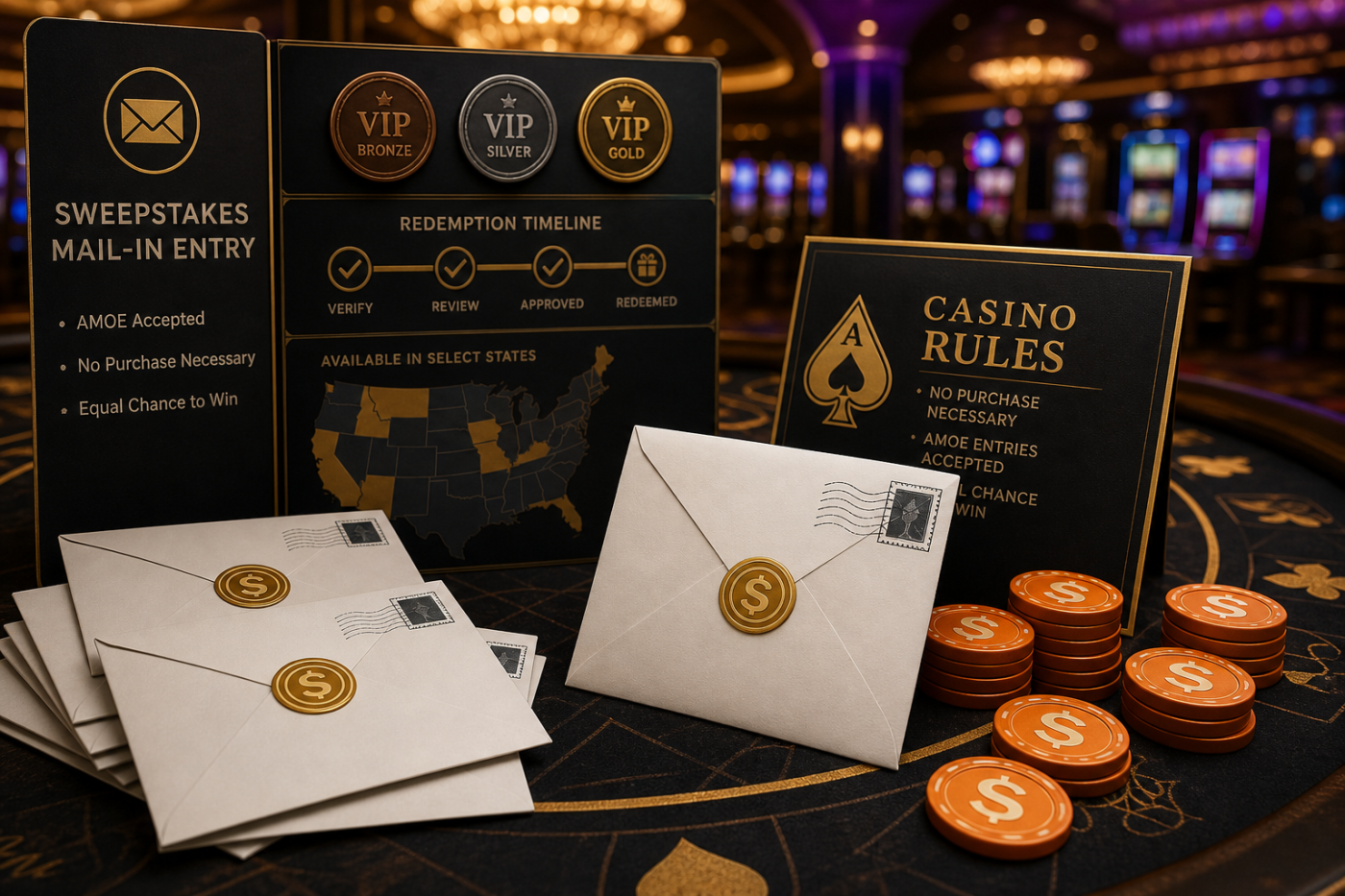
Short Answer: There is no single federal law that makes sweepstakes casinos legal nationwide. Operators generally structure their promotions around sweepstakes concepts such as no-purchase entry, while state gambling and sweepstakes laws determine whether a particular casino-style model can operate in a state. A dual-currency system or AMOE does not automatically make an operator legal everywhere.
By Owen Sullivan, Sweeps Flow Editorial | Updated September 2026
The legal explanation for sweepstakes casinos is more complicated than “they found a federal loophole.”
Federal law regulates parts of sweepstakes advertising and promotion, including certain no-purchase disclosures. State law still plays a major role in deciding whether casino-style sweepstakes activity is permitted.
That is why the same operator can be available in one state and excluded in another.

Quick Take
-
There is no federal sweepstakes-casino license that makes the model legal nationwide.
-
No-purchase entry is an important sweepstakes principle, but it does not override state gambling law.
-
AMOE means Alternative Method of Entry. The available method depends on the operator and promotion.
-
Gold Coins and Sweeps Coins are commonly separated, but a dual-currency structure does not itself prove legality.
-
Some states now expressly prohibit certain online casino-style sweepstakes models.
-
Operator exclusion lists can change as laws, enforcement, or business decisions change.
-
Check both the operator's current rules and official state information when legality matters.
Is there a federal law that makes sweepstakes casinos legal?
No single federal statute authorizes sweepstakes casinos throughout the United States.
Federal law does contain rules that matter to sweepstakes.
For example, federal postal law defines a sweepstakes, for purposes of those mailing provisions, as a game of chance for which no consideration is required to enter. The same statute requires certain mailed sweepstakes promotions to disclose that no purchase is necessary and that making a purchase will not improve a person's chances of winning.
The Federal Trade Commission also treats legitimate sweepstakes as free to enter and prohibits deceptive claims suggesting that a purchase is required or improves the odds.
Those rules help explain the no-purchase principle. They do not give an online casino-style sweepstakes permission to operate in every state.
Where do prize, chance, and consideration fit in?
A common way gambling laws analyze an activity is to look for three elements:
-
Prize: Something of value can be won.
-
Chance: The result depends on chance.
-
Consideration: Something of value is given to participate.
If all three are present, an activity may fall within a state's definition of gambling or lottery activity.
A free entry method can matter because it changes the consideration analysis.
The important limitation is that states define and apply these concepts differently. Some states also address indirect consideration or casino-style dual-currency systems specifically.
Removing a direct purchase requirement therefore does not end the legal analysis.
What is AMOE, and why does it matter?
AMOE means Alternative Method of Entry.
It is a no-purchase route described in a sweepstakes promotion's official rules. Depending on the operator, it may involve postal mail, an online process, or another method.
A useful AMOE review asks:
-
Who is eligible?
-
What process must be followed?
-
Are there request limits?
-
Are codes or exact wording required?
-
Which states are excluded?
-
Does the free entry receive the same stated chance of winning as a purchase-related entry, where applicable?
AMOE helps demonstrate how the no-purchase side of a promotion works.
It does not prove that the entire casino-style product is legal in a particular state.
For more detail, read What Is AMOE at a Sweeps Casino? and the Sweeps Casino AMOE Mail-In Guide.
How does the dual-currency model work?
Many sweepstakes casinos separate social play from promotional sweepstakes play.
| Feature | Gold Coins | Sweeps Coins |
|---|---|---|
| Main purpose | Social casino-style entertainment | Promotional sweepstakes play |
| Cash value | The balance itself generally has no cash value | Not cash; used as promotional sweepstakes currency |
| Purchase connection | Gold Coin packages may be sold | SC may be provided separately through promotions or no-purchase methods |
| Prize path | Gold Coin balances are not normally redeemed for cash or gift cards | Eligible prizes resulting from SC play may become redeemable under the operator's rules |
| What to check | Package and virtual-currency terms | Eligible play, expiration, redemption rules, KYC, and state eligibility |
The separation is part of how many operators structure their products.
It is not a legal guarantee. States can decide that a particular dual-currency casino-style system still falls within prohibited gambling or sweepstakes activity.
For the coin mechanics themselves, read Gold Coins vs Sweeps Coins.
Why state law matters so much
State law is not a small exception to the federal rules. It is a central part of whether an operator can offer casino-style sweepstakes in a particular location.
Several recent examples show how quickly the landscape can change.
California
California enacted AB 831 in October 2025. The law prohibits defined online sweepstakes games that use a dual-currency system, simulate gambling, and award cash or cash-equivalent prizes. It also distinguishes those ongoing gaming products from limited, occasional promotional sweepstakes used to market bona fide products or services.
New York
New York signed S5935 into law in December 2025. The law prohibits defined dual-currency online sweepstakes games that simulate casino-style gambling and offer cash or cash-equivalent prizes.
Maine
Maine enacted LD 2007 in April 2026. The law created a prohibition on defined online sweepstakes games and specifically addresses dual-currency systems.
Washington
Washington takes a restrictive approach to unauthorized gambling. The Washington State Gambling Commission says gambling is illegal unless specifically authorized and warns that certain activities marketed as “sweepstakes” do not qualify as lawful promotional contests.
These examples are not a complete 50-state legal guide. They show why no single national answer works for every operator and every player.
Legal-status checks experienced players use
You do not need to read every statute before opening an account. A few targeted checks can give you much better information than an old review or bonus page.
Check whether the source says “bill” or “law”
A proposed bill, a bill passed by one chamber, and an enacted law are different things.
Look for terms such as:
-
signed by governor
-
chaptered
-
enacted
-
effective date
Do not treat a headline about an introduced bill as if the restriction is already law.
Check the date the law takes effect
The signing date and effective date may be different.
If an operator announces an exit, compare its deadline with the actual law and the operator's current notice rather than assuming every account closes on the day a bill is signed.
Search the legal company name with your state
Find the operating company in the Terms of Use.
Then search the company name together with your state and terms such as:
-
attorney general
-
gaming commission
-
cease and desist
-
settlement
-
prohibited
-
enforcement
Regulatory actions are often filed under the legal company name rather than the casino brand.
Compare the Terms of Use with the Sweepstakes Rules
Check the state exclusions in both documents.
If one says your state is eligible and the other says it is excluded, do not guess which one controls. Ask official support before registering or spending money.
Save the version you relied on
If state eligibility matters to you, save a dated screenshot or PDF of the relevant eligibility and redemption terms.
This will not override a future law or rule change. It gives you a record of what the operator published when you made your decision.
Distinguish legal status from operator availability
An operator may voluntarily leave a state even when a new statute has not just taken effect.
Likewise, seeing a working signup page does not prove that the product is legally available where you are physically located.
What happens if your state becomes restricted?
Do not assume there is a universal grace period.
Operators may stop new registrations, disable purchases, limit gameplay, stop AMOE participation, or provide instructions for existing eligible balances. The exact response depends on the law, timing, and operator.
If your state's status changes:
-
Read the operator's official notice.
-
Check what happens to gameplay, purchases, AMOE, and redemption separately.
-
Save account and transaction records.
-
Review any stated redemption deadline.
-
Complete required verification through official channels.
-
Do not use a VPN or location workaround.
If the operator's instructions are unclear, contact official support before taking account action.
What makes an operator easier to evaluate?
No checklist proves legality by itself, but transparent operators give you more information to work with.
Look for:
-
current Terms of Use and sweepstakes rules
-
an identifiable legal company
-
clear state and age eligibility
-
understandable Gold Coin and Sweeps Coin rules
-
a genuine no-purchase process
-
published redemption requirements
-
clear verification procedures
-
official customer support
-
responsible-play controls
AMOE, KYC, and responsible-play tools are useful signals. None of them independently proves that an operator is lawful in your state.
For a broader trust review, read Are Sweepstakes Casinos Legit? and the Sweeps Flow Vibe Check methodology.

Taxes are a separate question
Tax reporting does not determine whether an operator is legally available in your state.
Prize redemptions can still have tax consequences. For payments made in 2026, current IRS instructions set a $2,000 Form 1099-MISC reporting threshold for certain prizes and awards, including amounts paid to a winner of a sweepstakes not involving a wager.
That is a reporting threshold, not a tax-free threshold. Income may still be taxable even when you do not receive an information form.
Keep your own records and speak with a qualified tax professional about your situation. Sweeps Flow does not provide tax advice.
A simple example
Suppose an operator sells a Gold Coin package and separately provides promotional Sweeps Coins.
The operator also publishes a no-purchase method for eligible participants.
That structure may support the operator's position that the Sweeps Coins are promotional rather than something directly purchased.
The analysis does not stop there.
The player's state may define indirect consideration differently, regulate dual-currency gaming specifically, or prohibit the casino-style sweepstakes product altogether.
That is why “no purchase necessary” is important without being the whole legal answer.
What to do before you play
Use this order:
-
Check whether the operator currently accepts players in your state.
-
Find the legal company named in the terms.
-
Check the effective date of the Terms of Use and sweepstakes rules.
-
Read the no-purchase entry instructions.
-
Review Gold Coin and Sweeps Coin terms.
-
Read redemption and verification requirements.
-
Search official state sources if legality is uncertain.
-
Set spending and session limits before making a purchase.
For related information, read:
Sweeps Flow Take
No single federal law makes sweepstakes casinos legal across the United States.
The model uses familiar sweepstakes features, including no-purchase participation, while state law determines whether particular casino-style promotions can operate in a given jurisdiction.
Check the state first, then the operator's current rules. A free entry method and two coin balances explain how the product is structured. They do not settle the legal question by themselves.
FAQs
Is there a federal law that makes sweepstakes casinos legal?
No single federal law authorizes sweepstakes casinos nationwide. Federal law regulates parts of sweepstakes promotion and consumer protection, while state law remains central to whether casino-style sweepstakes activity is permitted.
Why does “no purchase necessary” matter?
Traditional sweepstakes do not require a purchase to enter. Removing a purchase requirement can affect the consideration element of a gambling analysis, but state law may still regulate or prohibit a particular casino-style model.
Does AMOE make a sweepstakes casino legal?
No. AMOE shows how a promotion offers a no-purchase entry route. State law, the rest of the product structure, and the operator's conduct still matter.
Is the dual-currency model legal everywhere?
No. Several states have enacted or applied laws restricting dual-currency casino-style sweepstakes. Check the current rules for your location.
Are Gold Coins and Sweeps Coins the same thing?
No. Gold Coins are generally used for social casino-style entertainment. Sweeps Coins are promotional currency used for sweepstakes play. Exact rules vary by operator.
Can an operator leave a state even if there is no new ban?
Yes. Operators can change their own eligibility policies or exit a market for legal, regulatory, compliance, or business reasons.
Can I redeem if my state becomes restricted?
There is no universal rule. Check the operator's current state notice and redemption instructions. Do not assume a grace period exists.
Are sweepstakes prize redemptions taxable?
Prize income can be taxable. Current 2026 IRS reporting rules include a $2,000 threshold for certain prizes and awards, but receiving no form does not necessarily make income tax-free. Ask a qualified tax professional about your situation.
Compliance note: Sweepstakes, gambling, promotional, tax, and state eligibility rules can change. Check current official state sources and operator terms. This article provides general information and is not legal or tax advice.
Affiliate disclosure: Sweeps Flow may earn a commission if you visit or register with some operators through links on our site. Compensation does not change our editorial standards or legal-status checks.

Error